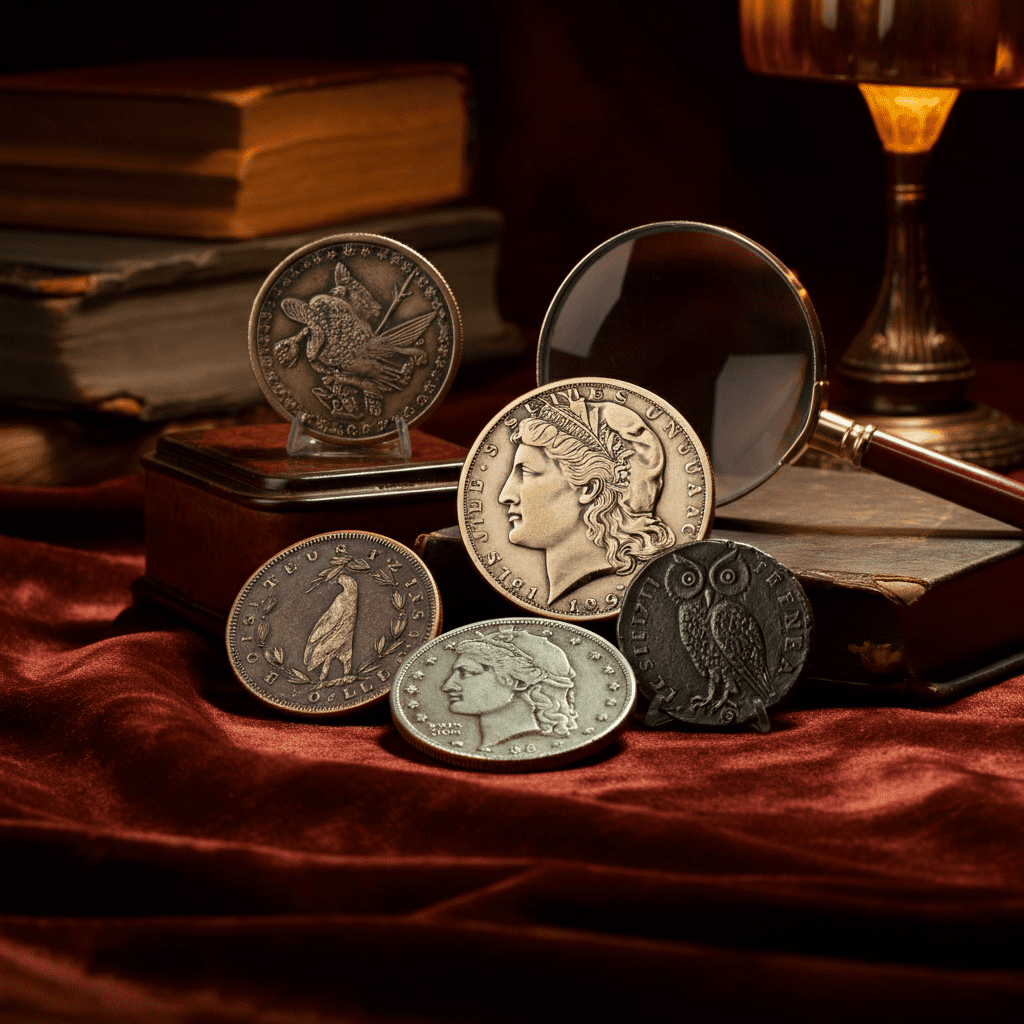

Holding a vintage coins is like holding a piece of history. Each scratch, date, and emblem tells a story of a different time and place. For collectors, these small metal discs are more than just currency; they are tangible links to the past, works of art, and valuable assets. Whether you’re just starting your collection or you’re a seasoned numismatist, navigating the global market for collectible coins can be a thrilling adventure.
This guide will walk you through the fascinating world of vintage coin collecting. We’ll explore the historical significance that drives their allure, uncover where to find these treasures, and provide essential tips for buying coins from other countries. You’ll also learn how a reliable shipping partner can make acquiring international collectibles seamless and secure.
The Allure of Vintage Coins
Why do people dedicate so much time and passion to collecting coins? The appeal is multifaceted, blending history, art, and investment into one compelling hobby.
A Connection to History
Every collectible coin is a historical artifact. An ancient Roman denarius might have been used to pay a legionary, while a Spanish piece of eight could have been salvaged from a sunken galleon. These coins offer a direct connection to the economies, cultures, and political events of their era. They feature portraits of rulers long gone, symbols of fallen empires, and artistic styles from different centuries. For many collectors, the story behind the coin is as valuable as the coin itself.
The Artistry in Your Palm
Beyond their historical context, coins are miniature masterpieces. Minting has always been a showcase of a nation’s artistic and technical skill. From the intricate designs of early Greek staters to the bold eagles on American silver dollars, the level of detail can be breathtaking. Collectors often appreciate the craftsmanship, the evolution of minting technology, and the aesthetic beauty of each piece in their collection.
An Investment for the Future
While passion often drives the hobby, the investment potential of collectible coins is undeniable. Rare coins, particularly those in high-grade condition, have historically shown a strong appreciation in value. Factors like rarity, metal content (gold, silver), historical significance, and condition all contribute to a coin’s market price. This makes numismatics not just a hobby, but a tangible asset class that can diversify an investment portfolio.
Global Demand and Availability
The market for vintage and collectible coins is a global one, with a passionate community of buyers and sellers spanning every continent.
Understanding the Demand
Demand is often driven by a combination of rarity and popularity. For example, certain US coins like the 1909-S VDB Lincoln Cent or the 1933 Saint-Gaudens Double Eagle are famous for their scarcity and command high prices. Similarly, ancient coins from the Roman or Greek empires have a broad, international following.
Regional interest also plays a significant role. Collectors in China may heavily pursue coins from specific dynasties, while European collectors might focus on medieval coinage. This global yet regionalized demand creates a dynamic and constantly shifting market.
Where Are the Coins?
Availability depends on what you’re looking for. Many common vintage coins are readily available through local dealers and online shops. However, truly rare and high-value pieces are harder to find. They often surface through major auction houses, specialized dealers, or from private collections being sold off.
The internet has revolutionized coin collecting, breaking down geographical barriers. A collector in Japan can now easily bid on a coin being auctioned in Germany. This increased access has made the hobby more exciting than ever, but it also introduces new challenges, particularly when it comes to international shipping.
Where to Find Vintage and Collectible Coins
Finding your next prized possession is part of the fun. Here are some of the most popular places to search for vintage coins:
- Coin Shows and Conventions: These events bring together dozens of dealers under one roof. They are fantastic places to see a wide variety of coins in person, speak with experts, and negotiate prices.
- Local Coin Shops: Building a relationship with a reputable local dealer is invaluable. They can offer expert advice, help you source specific coins, and provide fair appraisals.
- Online Marketplaces: Websites like eBay have vast coin sections, but buyers must be cautious. Always check a seller’s reputation and return policy.
- Auction Houses: For high-end and rare coins, major auction houses are the go-to venues. Heritage Auctions, Stack’s Bowers Galleries, and Classical Numismatic Group (CNG) are some of the most respected names in the industry.
- Online Collector Forums: Websites and forums dedicated to numismatics can be great places to connect with other collectors, learn, and sometimes find coins for sale or trade directly from peers.
The World’s Most Elusive and Expensive Coins
Imagine holding a small metal disc worth more than a luxury mansion. For most people, pocket change is something to spend or ignore. But for serious numismatists, certain coins represent the pinnacle of history, art, and obsession. These are not just currency; they are artifacts that have survived wars, shipwrecks, and government meltdowns.
The world of high-stakes coin collecting is filled with intrigue. From ancient masterpieces to modern minting errors, the most famous coins often have stories that rival Hollywood thrillers. This post explores the “Holy Grails” of numismatics—the rare, the expensive, and the nearly impossible to acquire. We will dive into the histories of legendary pieces like the 1933 Saint-Gaudens Double Eagle and the ancient Athenian Owl, examining why collectors spend millions to call them their own.
The Titans of American Numismatics
American coinage has produced some of the most valuable and controversial specimens in the world. The combination of documented mint records and a robust collector base drives prices into the stratosphere.
The 1933 Saint-Gaudens Double Eagle
Few coins possess a backstory as dramatic as the 1933 Saint-Gaudens Double Eagle. It is arguably the most famous gold coin in the world, and for a long time, owning one was illegal.
In 1933, President Franklin D. Roosevelt ordered the recall of gold coins to combat the banking crisis of the Great Depression. The Philadelphia Mint had struck 445,500 Double Eagles that year, but none were officially released into circulation. The government melted down almost the entire run. However, a handful escaped the mint, likely through illicit means.
For decades, the Secret Service seized these coins whenever they surfaced. One particular specimen, which had once belonged to King Farouk of Egypt, vanished and then reappeared years later. After a lengthy legal battle, the U.S. government declared this single coin legal to own. In 2021, it sold at auction for a staggering $18.9 million.
Why it’s so hard to get:
Aside from the astronomical price tag, the legal status of other 1933 Double Eagles remains murky. While a few others have been discovered and seized, legal ownership is generally restricted to that specific specimen sold at auction. You aren’t just buying gold; you are buying a survivor of a government purge.
The 1794 Flowing Hair Dollar
If you want to own the genesis of the American economy, you look for the 1794 Flowing Hair Dollar. Many experts believe this was the very first silver dollar struck by the United States Mint.
In the early years of the United States, producing a standard currency was a matter of national pride and legitimacy. The young nation wanted to show the world—and specifically colonial powers—that it could produce coinage of silver weight and purity to rival the Spanish Real or the Austrian Thaler.
The design features Lady Liberty with flowing hair on one side and an eagle on the reverse. Because the mint equipment was primitive, many of the 1,758 coins struck lacked detail or were damaged.
Why it’s valuable:
A specimen known as the “Greenberg-Pogue” coin is the finest known example. Its surface is mirror-like, suggesting it may have been a presentation piece held by founding fathers. It sold for over $10 million in 2013. Acquiring one in any condition is a feat; acquiring a pristine one is nearly impossible because they simply do not exist outside of permanent collections.
Ancient Treasures: The Roots of Money
While American coins dominate the multi-million dollar headlines, ancient coins offer a different kind of prestige. They connect collectors to the cradle of Western civilization.
The Athenian Owl Tetradrachm
While not always “rare” in the sense that only five exist, the Athenian Owl Tetradrachm is arguably the most recognizable ancient coin. Minted in Athens starting around the 5th century BC, this coin was the “dollar” of the ancient world.
The obverse features the helmeted head of Athena, the goddess of wisdom. The reverse shows her owl, standing with an olive spray and a crescent moon. This coin funded the Parthenon, paid for the wars against Persia, and facilitated trade across the Mediterranean.
Why it’s sought after:
The demand for “Owls” is massive. Collectors want them because they are thick, heavy silver coins that feel substantial in the hand. They are a direct link to Socrates, Plato, and Pericles. While you can find lower-grade examples relatively easily, finding a “full crest” Owl—where the entire helmet crest of Athena is visible and the nose isn’t cut off—is a significant challenge. High-grade, perfectly centered examples command high prices and fierce competition.
The Eid Mar Denarius
This is a coin soaked in blood and history. The “Eid Mar” (Ides of March) denarius was minted by Brutus in 42 BC to celebrate the assassination of Julius Caesar.
The coin brazenly features two daggers flanking a liberty cap, with the inscription “EID MAR.” It is one of the few instances in history where a murder weapon—or rather, the celebration of the act—was stamped onto currency. Brutus used these coins to pay his troops during the civil war that followed Caesar’s death.
Why it’s difficult to get:
Silver examples are rare, but gold examples are practically mythical. For centuries, only two gold examples were known to exist. A third surfaced recently, selling for millions, but was later repatriated to Greece due to looting concerns. The provenance (history of ownership) of these coins is scrutinized heavily, making the acquisition process a legal minefield as well as a financial one.
The Allure of Errors and Mysteries
Sometimes, mistakes create the most value. Mint errors are highly prized because mints are designed to be perfect. When they fail, they create unique rarities.
The 1913 Liberty Head Nickel
This coin technically shouldn’t exist. In 1913, the U.S. Mint replaced the Liberty Head design with the Buffalo Nickel. No Liberty Head nickels were authorized for that year. Yet, five of them surfaced years later.
It is widely believed that a mint employee struck these five coins clandestinely and smuggled them out. For decades, the existence of the coins was a rumor. Eventually, they appeared in the collection of a wealthy numismatist.
Why it’s exclusive:
There are only five. Three are in museums. That leaves only two that could theoretically enter the private market. When one does comes up for auction, it is a major global event. The sheer scarcity makes it one of the most coveted objects on the planet.
The 1804 Silver Dollar
Known as the “King of American Coins,” the 1804 Silver Dollar is famous for being a deception. These coins were not actually minted in 1804. They were struck in the 1830s as diplomatic gifts for Asian rulers.
The U.S. government wanted to present proof sets of coins to foreign dignitaries, but they didn’t have any silver dollars in stock. Mint employees used old dies to strike coins dated 1804.
The difficulty factor:
Only 15 specimens are known to exist. They are divided into three “Classes” based on when and how they were struck. Owning an 1804 dollar is the mark of a world-class collection. The opportunity to buy one might only happen once in a collector’s lifetime.
Why Are These Coins So Difficult to Acquire?
It is not just the price tag that makes these coins elusive. Several factors combine to make acquiring them a Herculean task.
1. Institutional Hoarding
Many of the world’s rarest coins are locked away in museums like the Smithsonian or the British Museum. Once a coin enters a museum collection, it rarely leaves. This permanently shrinks the available supply for private collectors.
2. The “Black Hole” Collections
Some ultra-wealthy private collectors buy rare coins and hold them for decades. These collections act like black holes; coins go in and don’t come out until the owner passes away or decides to liquidate. A specific rarity might disappear from the market for 40 or 50 years.
3. Provenance and Fakes
When a coin is worth millions, counterfeiters will try to replicate it. Buying a high-value rare coin requires navigating a minefield of fakes. Buyers must rely on extensive documentation, expert authentication, and third-party grading services. The fear of buying a forgery keeps many potential buyers on the sidelines.
4. Legal Restrictions
As seen with the 1933 Double Eagle and the Eid Mar Denarius, cultural heritage laws and government ownership claims can make buying certain coins risky. Collectors must ensure that a coin has a clean legal history and wasn’t looted or stolen.
Conclusion
The pursuit of world-famous collectible coins is about more than accumulating wealth. It is a chase for immortality. The 1794 Flowing Hair Dollar represents the birth of a superpower; the Athenian Owl represents the dawn of democracy; the 1933 Double Eagle represents the resilience of value in the face of economic collapse.
Acquiring these pieces requires patience, vast resources, and a bit of luck. For those who succeed, the reward is guardianship over a piece of history that will outlast us all. Whether you are hunting for ancient silver or forbidden gold, the stories these coins tell are worth their weight in any currency.
Tips for Buying Collectible Coins from Another Country
Purchasing a coin from an international seller opens up a world of possibilities. However, it requires careful planning to ensure a smooth and secure transaction.
1. Verify Authenticity
The risk of counterfeits is higher in a global marketplace. Whenever possible, buy coins that have been authenticated and graded by a reputable third-party grading service like PCGS (Professional Coin Grading Service) or NGC (Numismatic Guaranty Company). Their certification provides a strong guarantee of a coin’s authenticity and condition.
2. Understand Pricing and Payment
Coin prices can vary significantly from one country to another. Research recent sale prices for similar coins in comparable condition to ensure you’re getting a fair deal. When paying an international seller, use secure methods like PayPal or a credit card, which offer buyer protection. Be mindful of currency conversion rates and any associated fees.
3. Navigate Customs and Taxes
Importing collectibles can involve customs duties and taxes. These regulations vary by country. Research your country’s rules for importing coins or numismatic items to avoid unexpected fees or delays. Some sellers may not be familiar with your country’s import laws, so the responsibility often falls on you, the buyer.
4. Solve the Shipping Challenge
This is often the biggest hurdle in international coin collecting. Many sellers are unwilling to ship internationally due to the complexities of customs, insurance, and the risk of loss. This can be frustrating when you’ve finally found that one perfect coin for your collection. This is where a dedicated package forwarding service becomes essential.
Shop and Ship Worldwide with DeliveringParcel
When an international seller won’t ship to your location, DeliveringParcel offers the perfect solution. As a premier package forwarding service, DeliveringParcel empowers you to shop from anywhere and ship everywhere, breaking down the barriers of international commerce.
With DeliveringParcel, you get a local shipping address in the seller’s country. You can have the seller ship your purchased coins to this address, and from there, DeliveringParcel handles the rest. Their experts manage the international shipping and customs documentation, ensuring your valuable coins are packaged securely and delivered right to your doorstep.
Using DeliveringParcel removes the biggest obstacle in global coin collecting. It gives you access to a worldwide inventory, allowing you to buy directly from dealers and auction houses that might otherwise be out of reach. You no longer have to miss out on a rare find simply because of shipping restrictions.
Your Global Collection Awaits
The world of vintage and collectible coins offers a lifetime of discovery, learning, and excitement. Each coin you add to your collection enriches your connection to global history and art. By understanding the market, knowing where to look, and using smart strategies for international purchases, you can build a collection that is both personally fulfilling and valuable.
Don’t let borders limit your passion. With services like DeliveringParcel, the entire world is your marketplace. It’s time to start your next historical adventure and find the coins that are waiting to tell you their stories.